Walk into any store today and gut health has its own shelf: probiotic drinks, powders, gummies.
But the bacteria in your gut mostly live on something much older and simpler. They live on fibre from the food in your kitchen. And Indian kitchens have always been full of it.
This guide explains what actually feeds your gut, which everyday foods do it best, and how to start without overhauling how you eat.
What “Gut Health” Actually Means
Our intestines are home to trillions of microbes, together called the gut microbiome. When these microbes ferment fiber that reaches the large intestine, they produce short-chain fatty acids, mainly acetate, propionate and butyrate, which researchers study for their role in gut and metabolic health.
Diet is one of the biggest factors that shapes which microbes thrive. But scientists are still working out what an ideal microbiome looks like, so be cautious of anyone who promises to “fix” your gut with a single food.
One quick distinction: probiotics are live bacteria, found in foods like curd. Prebiotics are fibers that feed the bacteria already living in you. This post is about the second kind, because that is where everyday staples do most of their work.
Why Variety Matters
In 2018, the American Gut Project, a citizen-science study of more than 11,000 people across 45 countries, found that people who ate more than 30 different types of plants a week had a more diverse gut microbiome than those who ate 10 or fewer.
This is an association, not proof, and the researchers say it isn’t yet clear what that diversity means for long-term health. But the practical takeaway is simple and gentle: eat a wider mix of plant foods.
In an Indian kitchen, that mix is easier than it sounds:
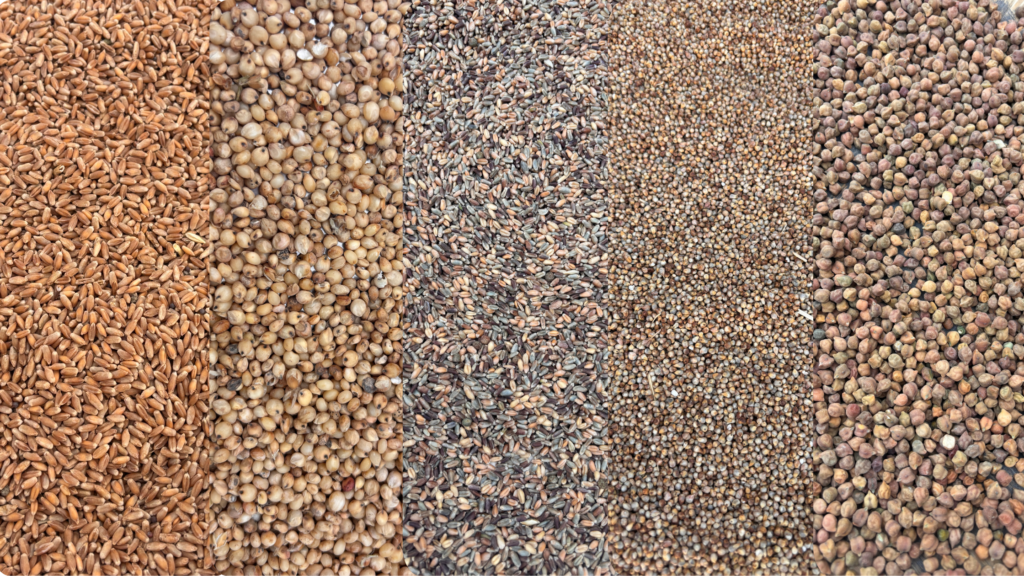
A multigrain atta made from wheat, bajra, jowar and chana spans at least four different plants in a single roti. Different dals count as different plants. Moong, masoor, urad and chana are separate foods. Different grains count too. Wheat, bajra and jowar are three different plants. Chana dal, besan and sattu are all chickpea, so they count once.
Whole Grains: Why the Bran Matters
Most of a wheat grain’s fibre sits in the bran. Wheat bran contains a fibre called arabinoxylan, which gut bacteria can use as food.
A 2019 systematic review looked at 42 human studies on intact cereal fibre, including wheat bran. Thirty-nine of them reported a positive effect on the gut microbiota. Most of those studies were short, so the longer-term picture is less clear.
This is why the difference between refined and whole-grain flour matters. Refining strips away much of the bran, and with it much of the fiber. Our guide to whole grain vs whole wheat explains how to tell what’s actually in your atta, and our guide to fiber in the Indian diet covers how much you need.
For reference, our Multigrain Atta has 9.52g of dietary fiber per 100g, and our Red Wheat Atta has 9.21g.
Dal and Pulses: Fiber Plus Resistant Starch
Pulses are one of the richest everyday fiber sources. A review of their fiber content puts them at roughly 10 to 34g of dietary fiber per 100g of dry weight, depending on the pulse.
Pulses also contain resistant starch, a type of starch that escapes digestion in the upper gut and is fermented by gut bacteria instead. Studies suggest that regularly eating pulses supports the growth of beneficial bacteria and raises short-chain fatty acid production, though much of that research is still preclinical.
Unpolished dal keeps more of its outer layer, where some of the fiber sits. We explain the difference in unpolished vs polished dal.
If dal makes you gassy, building up slowly, soaking it first and cooking it thoroughly often helps. Moong is usually the easiest place to start. All our Dals are unpolished.
Breakfast: Daliya and Sattu
Breakfast is an easy place to add fiber.
Daliya is wheat broken into coarse pieces, so it is only as whole-grain as the wheat it was made from. Our Red Wheat Daliya has 8.5g of fiber per 100g. If you’re deciding between daliya and oats, read our dalia vs oats comparison.
Chana sattu and besan are high-fiber flours. Our Chana Sattu has 16.22g of fiber per 100g, and our Besan has 13.52g. These are figures per 100g of dry flour, and a normal serving is much smaller.
Go Slowly
If your current diet is low in fiber, don’t jump to a high-fiber diet overnight. A sudden increase can cause bloating and discomfort. Add one change at a time, build up over a couple of weeks, and drink enough water as you go.
A Simple Week of Variety
This isn’t a diet plan, just a way to rotate what you already cook:
On the side: a different vegetable or fruit each day, plus nuts or seeds when you can
Dals: a different one on different days (moong, masoor, urad, chana)
Flours: wheat, multigrain and besan across the week
Breakfasts: daliya on some days, sattu or besan chilla on others
Gut-friendly eating doesn’t need special products. It needs whole grains, a variety of dals, and the patience to build a habit. That is what we make: whole grains and unpolished dals, grown on our own farms in Bundelkhand.